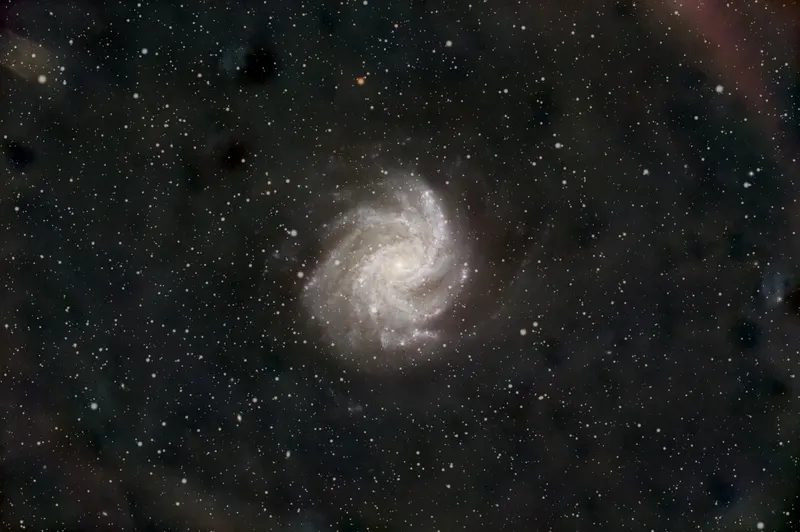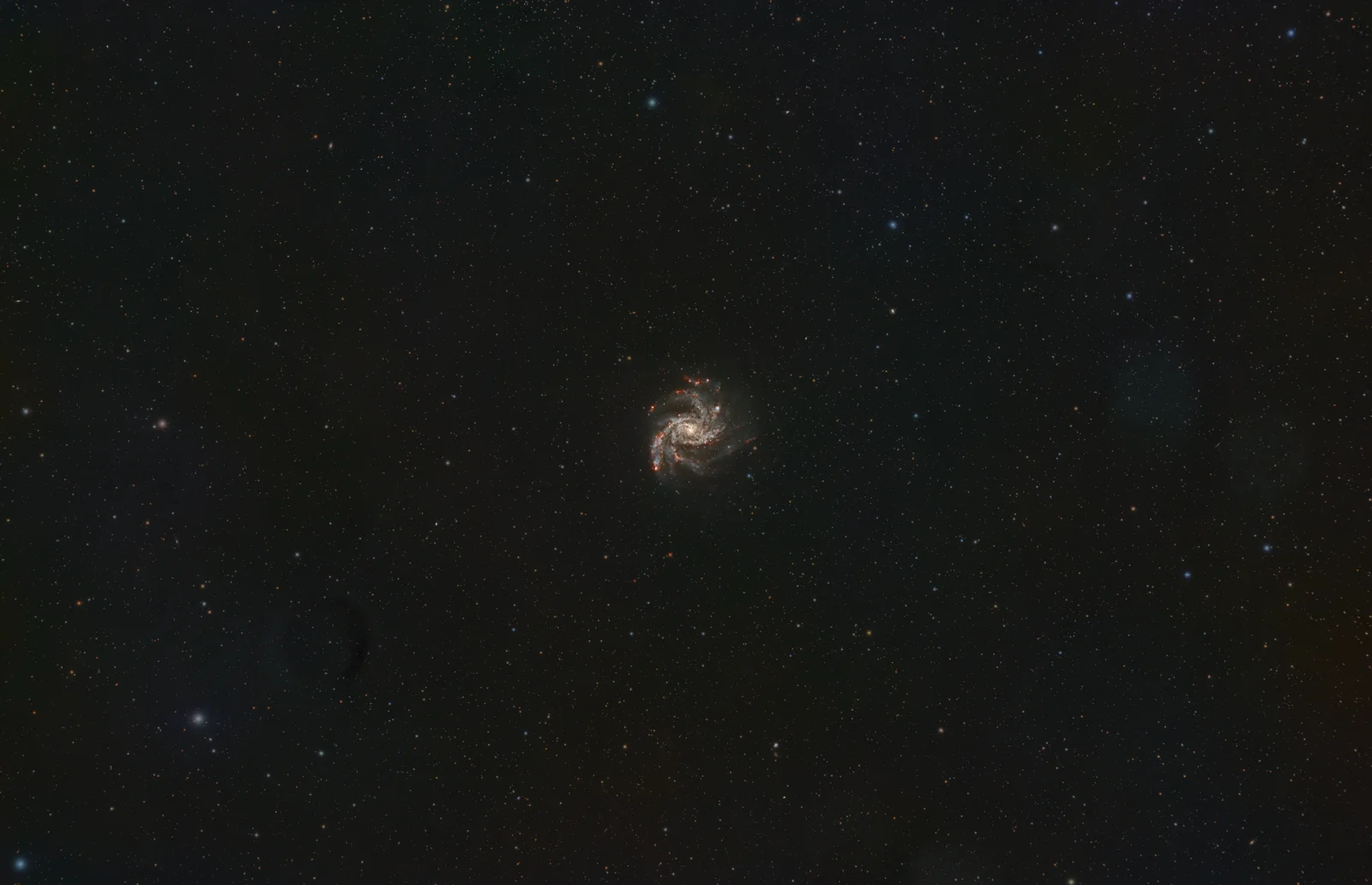
Fireworks Galaxy
A face-on spiral that has produced ten observed supernovae in the last century, more than any other known galaxy, thanks to its very high rate of star formation.
Distance about 25 million light-yearsSize about 40,000 light-years across
25 h total exposure over the nights of Aug 10, 2026 – Aug 31, 2026, taken with the Lunt 100 mm refractor (night configuration) at 714 mm focal length on the Celestron CGX-L mount, with the ZWO ASI2600MM Pro through Luminance, Red, Green, Blue, Hα filters (ZWO narrowband and LRGB); guiding: ZWO ASI220MM Mini.
Version: LRGB
How this version was processed
- GraXpert AI background extraction
- BlurXTerminator correct-only
- configure Gaia DR3 + DR3/SP
- plate solve
- SPCC
- BlurXTerminator sharpen
- NoiseXTerminator
- StarXTerminator
- stars: colour-preserving arcsinh stretch
- luminance (L) processing + LRGBCombination
- magenta fringe removal (inverted SCNR)
- HDRMultiscaleTransform (core)
- colour saturation (starless +0.12)
- colour saturation (stars +0.35)
Stacking: B 73 used/21 rejected, FWHM 3.2-3.2px; G 77 used/22 rejected, FWHM 3.1-3.1px; Ha 162 used/18 rejected, FWHM 3.3-3.3px; L 230 used/64 rejected, FWHM 3.0-3.0px; R 72 used/29 rejected, FWHM 3.2-3.2px